Based on the novel of the same name, Let the Right One In is a Swedish horror film directed by Tomas Alfredson that centers on the bittersweet story of a bullied boy, a strange girl and the relationship that develops between them. The movie deals with themes of loneliness, our desperate need for human connection, the blurred lines that spring from love, the inevitability of our own identity, and, being a horror film, fear. What is more, I would argue fear is the central theme in this movie. That is, our fear of the Other. In this case, (spoiler alert) the Other is a vampire. Nevertheless, the Other can take many identities. Simply put, the Other is whoever or, in cases of objectification, whatever we consider different to us. Fear of the Other is one of our greatest fears.
For most people, different can be uncomfortable, uncertain, and, worst of all, makes us feel inadequate. In the movie, inadequacy stems from the girl’s obvious physical superiority and, it must be noted, her voracious appetite. Although small and dainty in appearance, she can take on individuals that double or triple her in size. In comparison, the humans she encounters—and, by extension, the viewer—are feeble and helpless. Therefore, letting the right one in becomes a matter of life and death.
Yet, our feelings of inadequacy don’t only spring from physical comparisons. They can arise from class divides, cultural incompetence, and even guilt over historical wrongdoings. Inadequacy is a tricky and complicated feeling because it deems us vulnerable and less than ideal. We tend to prefer that which we are familiar with, that which we know what to expect and that we perceive as straightforward and simple.
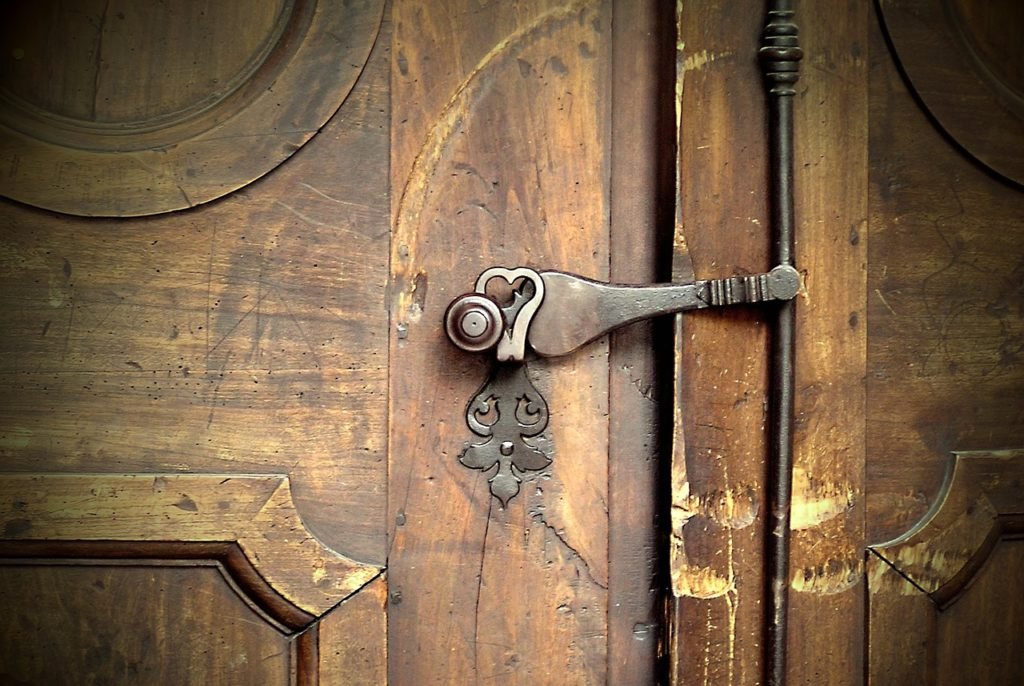
Therefore, the title of the film doesn’t only appeal to our internalized drive of being selective when allowing someone in, but to our fear of letting the wrong one slip in through the door. And, much like the identity of the Other, our doors also take different shapes and forms. Doors represent the threshold, the border between the space we control and that which we don’t. Doors can be literal, such as the entryway to our homes and houses; and can be metaphorical, like the entry ports of our countries. These may not be doors but they serve the same function of controlling who goes in and out. Doors can also allude to acceptance into a group, be it the admissions process into college, or the threshold an employee may find at work between being an independent contributor and becoming part of middle and upper management.
Consequently, there are many, many doors, and many, many Others. As a multicultural woman, I have found myself to be the Other on several occasions. Much like the little girl in Alfredson’s movie, sometimes I wished I wasn’t… but that is the inevitability of identity. We are who we are. Most importantly, it is our right to be who we are. However, I feel it important to make a disclaimer: unlike the character in the movie, I’m not a vampire (I have pictures of me basking in the sun to prove it). Still, what all this boils down to is a matter of diversity. Namely, whom are we comfortable opening our doors to, and how do we expect them to behave once we do.
Not too long ago, I participated in a group discussion about the challenges of championing diversity in towns where many residents have lived for decades if not generations as relatively homogenous groups. As a result, more often than not newcomers can be seen as disruptors. During one particular discussion, one person came forth to say diversity depended not only on letting newcomers in but on the newcomer’s disposition towards complying with the customs and expectations of the established group. That is, the newcomer’s ability to “fit in.” What came as the biggest shock to me wasn’t the statement itself. I have heard this before, usually as a ‘This is how things are done here.’ What drew my attention was the fact that this person was a Black individual who was talking from personal experience.
At the time, I said nothing. There was something heartbreaking in hearing an adult—and very accomplished one at that—say they had to willingly mold their identity to be accepted. Of course, this was one individual but it made me think about the experience of Black men in America and the many expectations they have to comply with to avoid prejudice and worse. However, fitting in is precisely what diversity is not. One of the many benefits that comes with diversity is expanding awareness by exposing both “established” individuals and newcomers to different points of view, identities and life experiences. In this coming together everyone learns and grows.
Diversity is never a one-way street. When individuals feel they have to ‘normalize’ themselves to fit the status quo and others’ expectations, all the benefits of diversity are lost. Diversity is not a guest list, it’s an open door. So perhaps it would do us good to reassess our stories about the Other and strip them of foreboding. At different points in our lives, we all find ourselves at risk of vampirizing and dehumanizing the Other. It is up to us to resist the urge or succumb to our fears. And yet, here is a final thought which I pose as a question: what if our biggest fear is not the unknown Other but the underlying message that the Other encapsulates? That is, what if our greatest fear is that eventually, at some point, it may be us who are made into the Other by those at the door? Letting in the ones who remain outside can be scary for those who’d prefer to stay in control; but, in changing our narratives we can also change our worst nightmares into dreams.